
What Is a Normal Resting Heart Rate?
Have you ever noticed your heartbeat when you’re completely at rest? Or wondered whether your heart is working harder than it should, even when you’re doing nothing? These questions are more important than they seem.
Understanding what is a normal resting heart rate can reveal how efficiently your heart functions and whether your body is under stress without obvious symptoms.
Your heart keeps beating quietly in the background, while you sit, relax, or sleep, but changes in this resting rhythm can provide early clues about your overall health. Dr. Shaloob explains that your normal resting heart rate is one of the simplest yet most powerful indicators of cardiovascular well-being.
A consistently higher or lower rate may signal dehydration, stress, poor fitness, hormonal changes, or underlying medical conditions. Monitoring your resting heart rate regularly helps you notice subtle shifts early and take timely steps to protect your long-term heart health.
What is a normal resting heart rate?
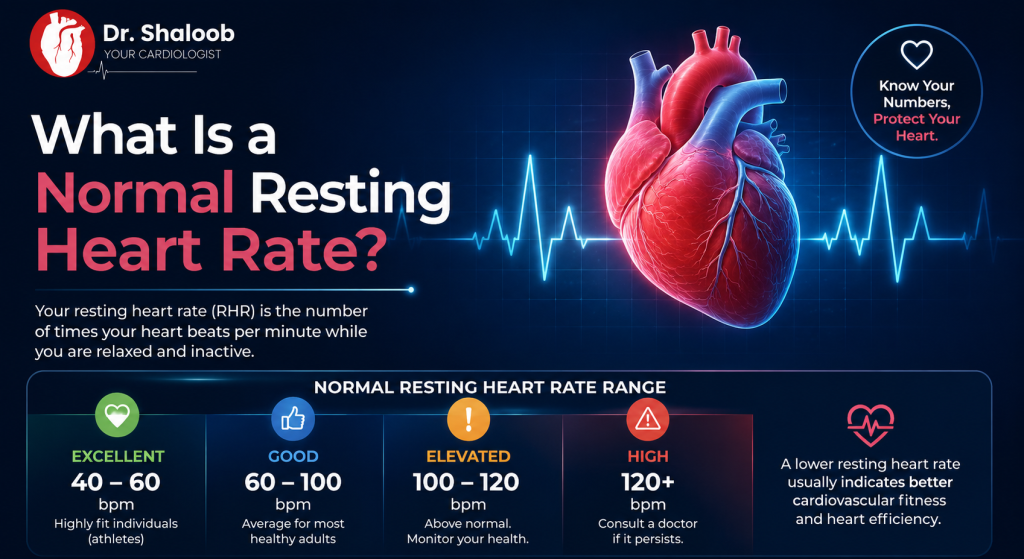
A resting heart rate is the number of times your heart beats per minute when you are relaxed, awake, and not physically active. For most people, the normal resting heart rate adults 60-100 bpm is considered standard.
However, many healthy adults fall between 60-80 bpm, which is often considered ideal. Athletes and highly fit individuals may have lower values due to better heart efficiency.
General understanding:
- 60-80 bpm is considered healthy for most adults
- 80-100 bpm may still be normal, but should be monitored
- Below 60 bpm may be normal in athletes
- Above 100 bpm at rest may require evaluation
This explains what’s a normal resting heart rate and why your personal baseline matters.
Did you know?Studies show that every 10 bpm increase in resting heart rate is associated with a higher risk of cardiovascular disease. Regular exercise can lower resting heart rate by 5-15 beats per minute. |
Understanding normal resting heart rate across different groups
Your normal resting heart rate is not the same for everyone. It keeps on changing depending on factors such as gender, age, fitness level, pregnancy, and even sleep. Understanding these differences helps you know what is normal for your body and when a change may need attention. Below is a breakdown of normal resting heart rate across different groups, including women, men, pregnancy, sleep, and athletes.
Normal resting heart rate for women
A normal resting heart rate for women is usually slightly higher than that of men. Changes in hormones, along with body size and metabolism, can impact heart rate.
Typical values:
- Healthy adult women: 65-85 bpm
- Physically active women: 60-75 bpm
- Athletes: 45-60 bpm
- During stress: may temporarily increase
If you’re wondering what is normal resting heart rate for women, the exact number depends on age, fitness level, and medical conditions.
Normal resting heart rate for women by age
- Women in 20s: 65-80 bpm
- Women in 30s: 65-85 bpm
- Women in 40s: 65-85 bpm
- Women above 50: 65-90 bpm
These ranges define normal resting heart rate women.
Normal resting heart rate for men
A normal resting heart rate for men is slightly lower on average.
Typical values:
- Healthy adult men: 60-80 bpm
- Physically active men: 55-70 bpm
- Athletes: 40-60 bpm
- Older men: may increase slightly
This represents the normal adult resting heart rate for males.
Normal resting heart rate during pregnancy
Pregnancy increases blood circulation, which raises the heart rate. A normal resting heart rate pregnancy is slightly higher than usual.
Typical range:
- Early pregnancy: 70-80 bpm
- Mid pregnancy: 75-90 bpm
- Late pregnancy: 80-100 bpm
- Increase of 10-20 bpm is common
A normal resting heart rate for pregnant women varies, but sudden rapid increase should be evaluated.
Normal resting heart rate while sleeping
Your heart slows during sleep because your body is relaxed. A normal resting heart rate while sleeping is usually lower than daytime readings.
Typical normal resting heart rate during sleep adults:
- Most adults: 50-65 bpm
- Active individuals: 45-60 bpm
- Athletes: 40-50 bpm
A lower resting heart rate normal during sleep often indicates efficient heart function.
Normal resting heart rate for athletes
Athletes usually have lower heart rates because their hearts pump blood more efficiently.
Typical normal resting heart rate for athletes:
- Endurance athletes: 40-55 bpm
- Regular athletes: 45-60 bpm
- Highly trained athletes may drop below 40 bpm during sleep
This is considered normal if there are no symptoms.
Normal resting heart rate by age
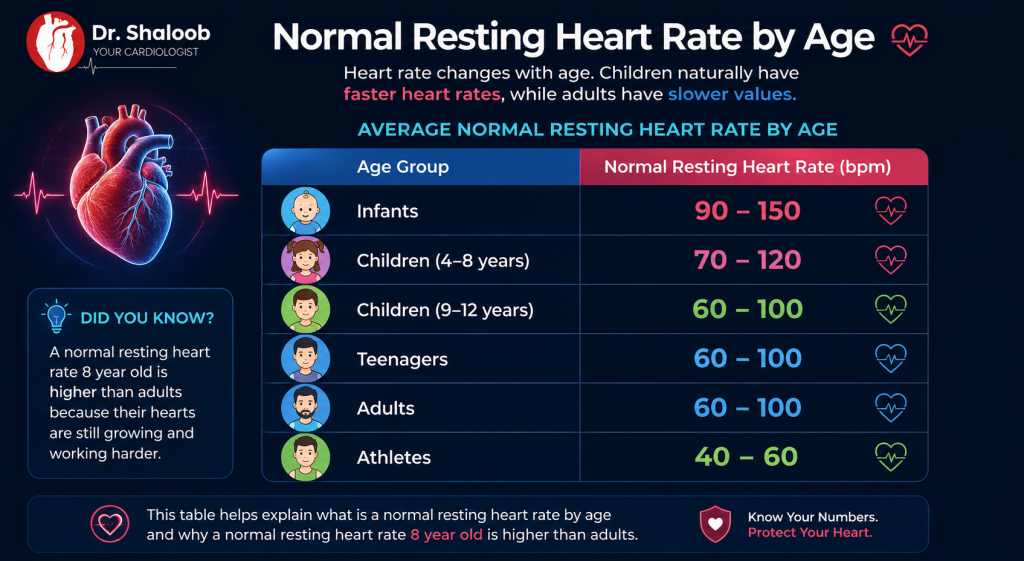
Heart rate changes with age. Children naturally have faster heart rates, while adults have slower values.
Average normal resting heart rate by age
Age Group | Normal Resting Heart Rate (bpm) |
Infants | 90-150 |
Children (4-8 years) | 70-120 |
Children (9-12 years) | 60-100 |
Teenagers | 60-100 |
Adults | 60-100 |
Athletes | 40-60 |
This table helps explain what is a normal resting heart rate by age and why a normal resting heart rate 8 year old is higher than adults.
Is it normal for heart rate to fluctuate while resting?
Yes. Many patients ask is it normal for heart rate to fluctuate while resting. Small variations are normal.
Heart rate changes due to:
- Breathing patterns
- Stress or anxiety
- Body position
- Hydration
- Temperature
Large or irregular fluctuations should be evaluated.
How to measure your resting heart rate?
Measuring your resting heart rate properly is important for accuracy.
Best time to measure
- Early morning after waking
- Before drinking coffee
- Before exercise
- While lying or sitting calmly
Manual method
| Using devicesYou can measure using:
|
These help determine your resting heart rate normal range.
Heart rate during exercise vs rest
Your resting heart rate differs from your exercise heart rate.
Typical values:
- Resting: 60-100 bpm
- Walking: 90-110 bpm
- Moderate exercise: 110-140 bpm
- Intense exercise: 140-170 bpm
People with lower normal resting heart rate adults recover faster after activity.
Causes of high resting heart rate
A resting heart rate higher than normal may be caused by:
Lifestyle causes:
|
Medical causes:
|
These explain why is my resting heart rate higher than normal.
Causes of low resting heart rate
A low normal resting heart rate range may occur due to:
- High physical fitness
- Athlete heart
- Medication effects
- Thyroid disorders
- Heart conduction issues
- Sleep apnea
Seek evaluation if symptoms occur.
Treatment options for abnormal resting heart rate
Treatment depends on the underlying cause.
Lifestyle treatment
- Regular aerobic exercise improves heart efficiency
- Stress reduction lowers heart rate
- Hydration stabilizes circulation
- Adequate sleep regulates rhythm
- Limiting caffeine helps control pulse
Medical treatment
- Treat thyroid disorders
- Manage anemia
- Adjust medications
- Treat infections
- Manage arrhythmias
When medical monitoring is needed
- Persistent heart rate above 100 bpm
- Resting heart rate below 50 bpm with symptoms
- Irregular rhythm
- Dizziness or fainting
When should you see a doctor?
If you notice any of these consult Dr. Shaloob:
- Resting heart rate above 100 bpm consistently
- Resting heart rate below 50 bpm
- Sudden changes in heart rate
- Irregular heartbeat
- Dizziness or fainting
- Chest discomfort
- Breathlessness
Early evaluation helps prevent complications.
Tracking your heart for better health
Understanding what is a normal resting heart rate helps you keep a watch on your heart health and detect early warning signs. The normal resting heart rate adults 60-100 bpm range, which applies to most individuals, but personal values vary based on age, gender, fitness, and medical conditions.
Tracking your normal resting heart rate range regularly provides valuable insight into cardiovascular health.
If your resting heart rate’s normal range changes suddenly or stays outside the typical range, consulting Dr. Shaloob can help identify the cause and guide appropriate care.
FAQs -
What is normal resting heart rate for adults?
For adults the normal resting heart rate generally ranges between 60 and 100 beats per minute. Athletes may have lower values.
What is a normal resting heart rate for women?
A normal resting heart rate for women is usually between 65 and 85 bpm, depending on age and fitness.
Why is my resting heart rate higher than normal?
In most of the cases, it is found that stress, dehydration, fever, thyroid disorders, anemia, and poor fitness can increase resting heart rate.
What is normal resting heart rate during sleep?
Normal resting heart rate during sleep usually falls between 50 and 65 bpm for most adults.
What is normal resting heart rate by age?
Children have higher heart rates, while adults typically range between 60 and 100 bpm.
What is normal resting heart rate for athletes?
Due to better cardiovascular efficiency, a well trained athletes may fall between 40 and 60 bpm.