
Heart Stent & Coronary Angioplasty in Dubai | Dr. Shaloob
Dr. Muhamed Shaloob is a board-certified cardiologist in Dubai with hands-on experience in coronary angioplasty, complex lesions, and high-risk interventions. If blocked arteries are affecting your heart health, he offers minimally invasive treatment to help restore normal blood flow and get you back on track.
At the angioplasty hospital, JTS Medical Centre in Dubai, advanced cath-lab technology and seamless ICU support ensures safe and efficient care.
If you’ve been diagnosed with blocked arteries or you’re recovering from a heart disease, our team offers evidence-based angioplasty treatment with compassionate, clear guidance from first consult to follow-up.

What is Coronary Angioplasty?
Angioplasty (Percutaneous Coronary Intervention, PCI) is a catheter-based angioplasty procedure that opens narrowed or blocked coronary arteries to restore blood flow.
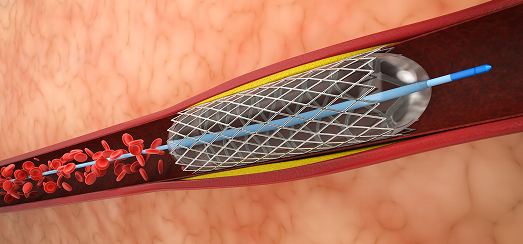
A thin tube is guided through a wrist or groin artery to the heart; a tiny balloon is briefly inflated to widen the narrowing, and a coronary angioplasty stent (usually drug-eluting) is placed to help keep the artery open.
Compared with open surgery, it is less invasive and typically offers shorter angioplasty recovery time.
When is Angioplasty Recommended?
- Acute heart attack to rapidly reopen the blocked artery.
- Persistent or worsening angina despite medications.
- High-risk stress test or coronary angiography showing significant stenosis.
- Selected cases of restenosis or stent failure, sometimes with specialized techniques (e.g., atherectomy).
Angioplasty Procedure in Dubai
- Preparation & imaging: You’ll have blood tests and coronary imaging (angiography). Most patients receive light sedation while awake.
- Access: Local anesthetic is given at the wrist (radial) or groin (femoral). A sheath allows catheters to pass to the heart under fluoroscopy.
- Balloon & stent: A guidewire crosses the blockage; a balloon expands the narrowing. In most cases, a drug-eluting stent is deployed to reduce re-narrowing.
- Medications: An antiplatelet therapy (such as aspirin along with a second agent) for a duration advised to prevent stent clotting.
- Monitoring: Vitals are continuously monitored during and after the angioplasty operation. You may have to stay overnight.
Angioplasty duration: It takes around 30–90 minutes for simple blockage cases; while complex disease may take longer.
Stent Options Available for Coronary Angioplasty in Dubai
When it comes to angioplasty stents in Dubai, there are a few different options depending on what your heart needs.
- Drug-eluting stents (DES): The most widely used type, these stents release medication directly into the artery wall to keep scar tissue from building up and blocking the vessel again.
- Bare-metal stents (BMS): Less commonly used today, these may be considered for patients who cannot tolerate long-term blood-thinning medication, such as those with a higher risk of bleeding.
- Special techniques: For more complex blockages, additional tools like intravascular imaging, atherectomy, or laser treatment may be used alongside stenting to get the best possible result.

Safety, Risks & Success
Like any procedure, angioplasty carries some risks.
Angioplasty risks in Dubai include:
Minor vessel injury, irregular heart rhythms, a reaction to the contrast dye, or temporary strain on the kidneys.
In rarer cases, complications such as heart attack, stroke, or the need for emergency bypass surgery may arise, though these outcomes are uncommon.
With Dr. Shaloob’s expertise and precise technique, angioplasty success rates are high and serious complications are uncommon. Your individual risk depends on age, kidney function, diabetes, lesion complexity, and number of blocked arteries.
Recovery & Follow-up
For an angioplasty recovery in Dubai you need to adhere to the instructions given by the surgeon.
- Hospital stay: Same-day discharge or 24-hour observation for most; longer if performed for a heart attack or complex disease.
- At home: Keep the area where the catheter was inserted clean and dry, and avoid lifting anything heavy for the first few days. Some bruising or tenderness around the site is completely normal.
- Returning to routine: Most people can get back to desk-based work within about a week. Anything more physically demanding should wait until your doctor has given the all-clear.
- Lifestyle & rehab: Cardiac rehabilitation, heart-healthy diet, exercise, and strict adherence to prescribed medicines are key to long-term success after angioplasty treatment.
Angioplasty Cost in Dubai
Angioplasty cost depends on several factors, including how many arteries need treatment, the number of stents required, the hospital facilities used, and what your insurance covers.
After a full evaluation, Dr. Muhamed Shaloob will give you a clear, straightforward cost estimate, and our team will do their best to help with any insurance pre-approvals.

Why Choose Angioplasty in Dubai With Dr. Shaloob?
- High-risk & complex PCI expertise: Whether it's multivessel disease, diabetes, or a completely blocked artery, Dr. Shaloob has the experience to handle cases that others may find challenging.
- Radial-first approach: Whenever possible, access is made through the wrist rather than the groin - a smaller entry point that means less discomfort, faster recovery, and a lower chance of bleeding.
- Evidence-based decisions: Use of intravascular imaging and current guidelines to optimize outcomes.
- Clear, compassionate care: Patients are informed throughout the treatment from diagnosis to post-procedural recovery with transparent communication and realistic expectations at every stage.
- Integrated heart care: From prevention to heart failure management, arrhythmias, and advanced imaging, experience comprehensive cardiology under one roof.
Ready to Take The Next Step?
Consult the best angioplasty doctor, Dr. Muhamed Shaloob, for precise diagnosis, tailored stent planning, and guided recovery. Recognized as one of the Best Heart Doctor in Dubai and regarded among the top 10 cardiologist in Dubai, he can help you understand your options for angioplasty in Dubai, discuss angioplasty procedures, and plan a safe, effective path back to heart health.
FAQs: Angioplasty in Dubai
1) What is angioplasty?
Angioplasty is a minimally invasive procedure that widens narrowed heart arteries using a ballon and a stent is used to restore blood flow. The angioplasty procedure restores blood flow to your heart muscles.
2) When is angioplasty recommended?
For heart attacks, unstable or persistent angina, or high-risk blockages confirmed on tests.
3) How long can a person live after angioplasty?
Many people go on to live for decades after the procedure. How long you live depends less on the angioplasty itself and more on how well risk factors like blood pressure, diabetes, cholesterol, and smoking are managed over time.
4) What happens after an angioplasty procedure?
You will be monitored for a short period in the hospital, provide access-site care instructions, antiplatelet medications, and a personalized recovery plan, often including cardiac rehab.
5) How risky is angioplasty?
Serious complications are rare when the procedure is performed at experienced cardiac centers. However, possible risks may include bleeding, damage to the blood vessel, heart attack, stroke, reactions to the contrast dye, and temporary kidney problems.
6) What is the success rate of angioplasty?
Success rates are generally high for suitable cases. Your cardiologist will give you a clearer picture based on the location of the blockage, its length, and your overall health.
7) How serious is angioplasty?
Angioplasty is less invasive than bypass surgery, but it is still an important heart procedure that needs an experienced medical team and proper follow-up care.
8) How long does angioplasty take?
Angioplasty procedure is mostly completed within 30 to 90 minutes. However, in some complex cases, it can take longer than usual.
9) How long is recovery after angioplasty?
Light activity can usually resume within 24 to 48 hours. Many patients return to work within a week, though this varies depending on your doctor’s guidance and the nature of your job.
10) How long do angioplasty stents last?
Stents are permanent implants. The goal is durable patency; success relies on medication adherence and risk-factor control.
11) How long do you stay in the hospital after angioplasty?
Many patients go home the same day or after one night. Those treated for a heart attack or a more complex case may need to stay a little longer.
12) Can you live 20 years after angioplasty?
Yes, absolutely, particularly when supported by a healthy lifestyle, the right medications, and regular follow-up with your cardiologist.
13) What foods should be avoided after angioplasty?
It’s best to avoid trans fats, high levels of saturated fat, heavily processed and salty foods, and added sugars. A heart-healthy diet built around whole foods makes a real difference to long-term recovery.
14) How much does angioplasty cost in Dubai?
Costs vary by complexity of the procedure and surgeon’s expertise. We’ll provide an individualized estimate after assessment.
15) Why choose angioplasty in Dubai with our cardiologists?
Experienced angioplasty specialists, modern cath-lab technology, radial-first comfort, and end-to-end cardiac care tailored as per your needs.