
What are the 4 stages of congestive heart failure?
Heart failure, frequently called congestive heart failure (CHF), is a serious, long-term condition marked by the heart muscle’s inability to pump adequate blood for the body’s requirements. Although a diagnosis can be challenging, grasping the disease’s progression is crucial for effective treatment and enhancing the quality of life.
Recognizing the 4 stages of congestive heart failure helps patients and cardiologists establish proactive treatment strategies.
Dr. Muhamed Shaloob, a leading cardiologist in Dubai, utilizes the widely accepted framework established by the American College of Cardiology (ACC) and the American Heart Association (AHA) to classify the progression of heart failure. This system defines four distinct stages of congestive heart failure: A, B, C, and D.
Understanding heart failure
Before exploring the stages of heart failure, it’s essential to define the condition. Heart failure is not the same as a heart attack (which is often a cause of heart failure).
Instead, it describes a situation where the heart muscle has become stiff or weak, preventing it from filling efficiently or pumping blood forcefully enough.
The heart’s inability to pump properly causes blood to accumulate, resulting in congestion, primarily in the lungs and extremities, thereby defining ‘congestive heart failure.
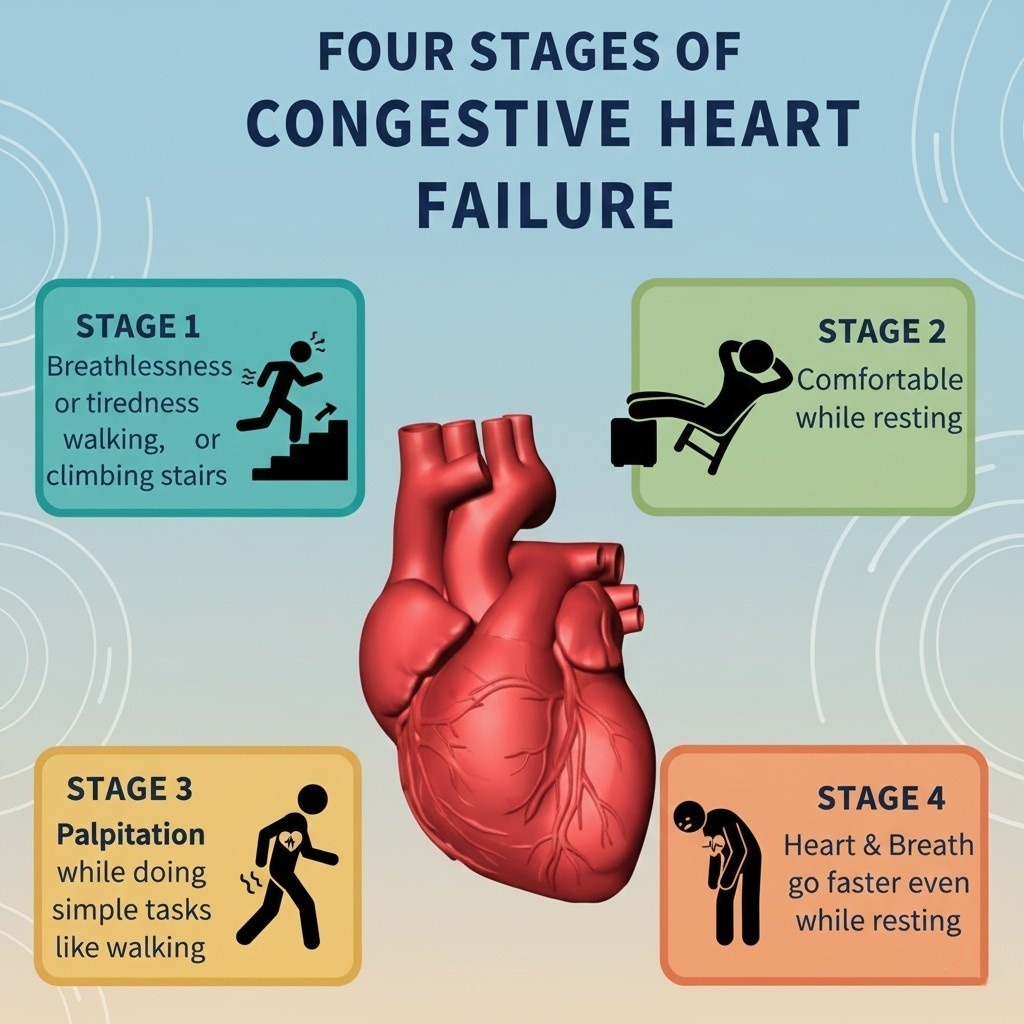
The two key heart failure classifications
When discussing heart failure, two major classifications are used:
1. ACC/AHA Stages (A, B, C, D) – Focus on progression
The ACC/AHA system is used to track the progression of structural disease and associated risk factors. This is the more crucial classification for guiding treatment and addressing the 4 stages of heart failure. It accounts for individuals who are at risk (Stages A and B) as well as those with established symptoms (Stages C and D).
2. NYHA functional classes (I, II, III, IV) – Focus on symptoms
The New York Heart Association (NYHA) system focuses purely on the severity of the patient’s symptoms and their limitation during physical activity. This helps doctors assess the current functional status of a patient in stage C heart failure.
NYHA class | Symptom description |
Class 1 | No limitation of physical activity. Ordinary physical activity does not cause undue fatigue, palpitations, or shortness of breath. |
Class 2 | Slight limitation of physical activity. Comfortable at rest, but ordinary activity results in symptoms. |
Class 3 | Marked limitation of physical activity. Comfortable at rest, but less than ordinary activity causes symptoms. |
Class 4 | Unable to carry on any physical activity without discomfort. Symptoms of heart failure are present even at rest. |

What are the 4 stages of congestive heart failure? (ACC/AHA)
Dr. Muhamed Shaloob reassures that identifying the correct stage is an important and achievable step, forming the foundation of effective management. Here is a breakdown of the 4 stages of congestive heart failure:
Stage A: High risk, no disease
This is the earliest stage, where patients do not have any physical or structural evidence of heart disease but possess significant risk factors for developing heart failure.
At this point, signs of stage 1 congestive heart failure are not yet present, and the focus is on prevention, a positive time to make changes and protect your future heart health.
Characteristics: No structural heart changes, no symptoms.
Symptoms include: Individuals with:
- High blood pressure (Hypertension).
- Diabetes.
- Obesity or metabolic syndrome.
- A strong family history of cardiomyopathy (heart muscle disease).
Treatment goal: The primary goal at this stage is to prevent heart failure by promoting lifestyle changes, controlling blood pressure and cholesterol levels, and educating patients to reduce their risk factors.
Stage B: Pre-heart failure
Patients in stage B heart failure have structural heart disease but have never experienced any symptoms related to heart failure. This means that, despite the heart’s damage, it is still compensating effectively.
Characteristics: Structural heart disease (e.g., previous heart attack, valve disease, or reduced ejection fraction) but asymptomatic.
Symptoms include: Those who have:
- Experienced a myocardial infarction (heart attack).
- Left ventricular hypertrophy (thickening of the heart wall).
- Significant asymptomatic valve disease.
Treatment goal: The treatment goal for Stage B is to prevent the onset of symptoms by using medications such as ACE inhibitors, ARBs, or Beta-blockers to limit further heart damage and maintain heart function.
Stage C: Symptomatic heart failure
This is the most common diagnosis for heart failure. Patients in stage C heart failure have evidence of underlying structural heart disease and have current or past symptoms of heart failure, such as fatigue, shortness of breath, or fluid retention.
The good news is that with the right management, many individuals continue to lead fulfilling and active lives. This stage correlates with NYHA Classes I–IV.
Characteristics: Structural heart disease with current or previous symptoms.
Symptoms include: Those who have they experience:
- Shortness of breath, particularly noticeable during physical exertion or when lying flat.
- Fatigue and reduced exercise tolerance are common.
- Swelling may occur in the legs, ankles, or abdomen.
Treatment goal: The treatment at this stage aims to relieve symptoms, prevent hospitalizations, and improve quality of life. This involves continuing Stage B medications, introducing diuretics, and considering advanced therapies as needed.
Stage D: Refractory/End-Stage Heart Failure
Patients who reach stage 4 congestive heart failure have advanced symptoms that are resistant to standard medical treatments. This means that even with maximized standard therapy, the patient experiences severe symptoms at rest.
Characteristics: Severe symptoms at rest, despite maximal medical therapy.
Treatment goal: The primary goal at this stage is to manage severe symptoms and maintain comfort. Treatment may involve heart transplantation, mechanical circulatory support, or hospice/palliative care based on individual needs.
- Mechanical circulatory support devices (like a Left Ventricular Assist Device or LVAD).
- Hospice/Palliative care.
What is the difference between stage 3 and stage 4 heart failure?
Stage C (often considered stage 3 congestive heart failure in older terminology) is characterized by symptoms managed by routine medications, while Stage D symptoms persist and are severe despite all possible standard treatments.
Expert heart care with Dr. Muhamed Shaloob
The essential first step in your care journey is to understand the four stages of congestive heart failure. Whether you have just been diagnosed with Stage A risk factors or are managing the complexities of Stage C, expert cardiology guidance is non-negotiable.
Dr. Muhamed Shaloob Best cardiologist in dubai offers comprehensive diagnostic and therapeutic care, ensuring a tailored treatment plan designed to halt progression and optimize your heart health. Schedule your consultation today to discuss your risks, symptoms, and the best course of action for managing your heart condition.
Frequently asked questions (FAQ’S)
Q1: What are the symptoms of stage 4 congestive heart failure?
Patients show severe, persistent symptoms even at rest, such as extreme shortness of breath and fatigue.
- Difficulty sleeping flat (orthopnea).
- Profound, persistent swelling may affect the legs, abdomen, or lungs.
- Frequent hospitalizations for fluid overload or low cardiac output.
Q2: What is the life expectancy for each stage of heart failure?
It is impossible to give a fixed life expectancy for each stage of heart failure as it varies greatly based on age, overall health, co-morbidities, and adherence to treatment. However, the stages indicate risk:
- Stage A & B: Generally excellent, near-normal life expectancy with proper risk factor management.
- Stage C: Highly variable, often measured in years, depending on the severity of the ejection fraction and response to medicine.
- Stage D: Prognosis is poor without advanced intervention (like transplant or LVAD), often measured in months or 1-2 years.
Q3: Can stage 3 heart failure be reversed?
While the underlying structural damage (Stage C) cannot be completely reversed, symptoms can often be managed or eliminated. Optimized medical therapy may help a patient transition from symptomatic Stage C to asymptomatic Stage B.
The goal is to prevent progression and improve functionality, showing that the effects of stage 3 heart failure can be mitigated.
Q4: How quickly does congestive heart failure progress?
How fast does congestive heart failure progresses is highly individualized. Progression can take years or even decades. It is typically faster in patients with:
- Poor control of underlying conditions (hypertension, diabetes).
- Persistent smoking or heavy alcohol use.
- Non-adherence to prescribed medications.
- Recurring heart events (e.g., heart attacks).
Q5: What is the difference between ACC/AHA and NYHA stages?
The heart failure classification explained difference is simple:
- ACC/AHA (A, B, C, D): It tracks the structural and clinical advancement of the disease, covering individuals who are currently at risk (Stages A and B). It guides long-term therapy.
- NYHA (I, II, III, IV): Focuses only on the patient’s current functional capacity and symptoms. It helps in short-term management and assessing the impact on daily life.
Q6: Can you provide a general overview of the congestive heart failure stages?
Yes. The gold standard heart failure classification explained is the American College of Cardiology/American Heart Association (ACC/AHA) system, which categorizes the disease into four stages: A, B, C, and D.
This system, which tracks the disease’s structural progression, is crucial for determining treatment options by stage of heart failure. Stages A and B focus on individuals at risk or with structural damage but no symptoms, while Stages C and D involve active or refractory symptoms.
Q7: What is heart failure stage b and how does it relate to stage 2 heart failure?
Heart failure stage b (Pre-Heart Failure) means the patient has structural evidence of heart disease (like previous heart attack or reduced ejection fraction) but has never shown any symptoms of stage 2 heart failure (NYHA Class II) or any other symptoms.
This stage is key because early and aggressive medication can prevent the progression to symptomatic heart failure. Stage B is often considered the anatomical equivalent of the older stage 2 heart failure terminology.
Q8: What is stage C heart failure?
Stage C is symptomatic heart failure (like what is stage 3 congestive heart failure), where symptoms are present but can be effectively managed with standard medications.
Q9: What is stage 4 heart failure?
Stage 4 is refractory or end-stage congestive heart failure, where severe symptoms persist even with maximized standard medical therapy.
Q10: What are the signs of stage 4 heart failure, and is stage 4 heart failure terminal?
Stage D is the most advanced form, characterized by symptoms present even at rest. The signs of stage 4 heart failure or end-stage congestive heart failure symptoms include extreme breathlessness at rest, profound fatigue, and frequent hospitalizations for fluid overload.
While the stage 4 heart failure terminal is a difficult question, Stage D requires advanced therapies (like LVAD or transplant) as standard medicine is no longer sufficient, leading to a significantly reduced stage 4 heart failure life expectancy without intervention.
Q11: What are the early warning signs of heart failure and what causes heart failure stages?
The early warning signs of heart failure are often subtle and include unexplained fatigue, mild shortness of breath during routine activity, and slight swelling in the ankles. Signs of stage 1 congestive heart failure (Stage A) are entirely preventative, focusing on risk factors like uncontrolled hypertension or diabetes.
What causes heart failure stages to progress is primarily the ongoing damage to the heart muscle from underlying conditions (like high blood pressure, coronary artery disease, or genetic issues) that are not adequately managed, leading to structural changes and eventually symptoms.
Q12: What is the life expectancy for each stage of heart failure?
Life expectancy for each stage of heart failure varies widely and depends on many individual factors (age, co-morbidities, adherence to medication). However, the classification helps predict risk:
- Stages A & B: Generally excellent, near-normal life expectancy with strict management of risk factors.
- Stage C (Symptomatic): Prognosis is highly variable, often measured in years, depending on the severity and response to medical therapy.
- Stage D (Refractory/End-Stage): Prognosis is significantly limited without advanced treatment options, which may include transplant or mechanical support.